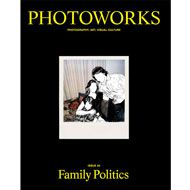
Photoworks, the National Portfolio Organisation, supported by the Arts Council England, curates exhibitions, commissions new work, and runs events, including the Brighton Photo Biennial. In addition, for the past 10 years, it has been producing a semi-annual magazine, showcasing new writing and photographic commissions. This autumn has seen issue 20 expand into the new format of a heftier annual tome: a 256 page catalogue filled to the brim with works by both new and established photographers and insights and discussions presented by writers on the subject.
At heart, Photoworks has always been about commissioning new work, says Director and Co-Editor, Celia Davies, and so this larger platform really takes the organisation back to its roots, providing time and space for just this. In addition, the newly adopted thematic approach – this time Family Politics – provides a focus for debate and a central idea to which contributors can respond.
“We believe photography is at its most interesting when viewed in relation to its wider cultural contexts,” state the editors in their introduction, and with the theme of family politics, contributions, both photographic and written, cover a plethora of related issues, coming from many different cultural angles. Susan Bright, for example, curator of Home Truths (the current exhibition at The Photographers’ Gallery and the Foundling Museum), looks at the theme of motherhood in photography, while Wendy Ewald, in conversation with Anthony Luvera, discusses the pedagogy and politics of her practice as an educator and photographer. Sarah James seeks out an equivalent of The Family of Man in the Eastern bloc countries and Terry Dennett takes a look at Jo Spence’s family album, offering insights into the photographer’s thinking.
Looking beyond our immediate family in the home, Claudia Sola undertakes a scintillating project tracing “relatives” across the world who share the same mitochondrial DNA haplogroup as her and then taking self-portraits of herself in their guise. Also considering the advances in medical technology, Bettina von Zwehl and Kelley Wilder look at fetal ultrasounds as exemplars of the latest means of photographic portraiture.
Pregnancy, birth and babies, domesticity, mealtimes… All the traditional earmarks of the family unit. In another essay, the curators of Who’s Looking at the Family from the Barbican Art Gallery in 1994 look back at the exhibition and consider what has changed in the interim. Further in, Lorie Novak, in conversation with Marianne Hirsch, talks about her practice of collating a digital archive of family photographs, Collected Visions, since 1992. The digital, of course, has a significant presence throughout, and, Martina Weinhart discusses this in depth in her article on how new media is transforming our experience of intimacy, based on her experience as curator of Privacy at the Schirn Kunsthalle earlier this year. An exhibition which examined how digital technologies and a culture of exhibitionism have blurred the lines between public and private, it in fact encapsulates the main theme I could draw from this printed collection of works: the modern family as a site and subject of dialogue between the private and the public.
As Roland Barthes put it in Camera Lucida in the early 80s: “The age of Photography corresponds precisely to the explosion of the private into the public, or rather into the creation of a new social value, which is the publicity of the private.” And as if in response both to this, as well as to Sarah James’ aforementioned quest, Andrew Kötting neatly concludes: “The distinction between private and public imagery has been transcended. Captured, amplified, distorted and disseminated. Facebook as The Family of Man.”
With plentiful debate and glorious high quality images throughout, this annual is a weighty, worthy and highly collectible album containing stellar work of both visual and written nature. It is a work to which anybody interested in art, photography, culture, or simply just family life, might return time and time again.
– reviewed by Anna McNay