__________
“Looking back, I am genuinely stunned that the museum thought it was a good idea to send an artist so ill-prepared to a war zone”, writes Mark Neville of his art residency hosted by the British Army in Helmand, Afghanistan in 2011. Back home, that same museum left the British photographer who was suffering from PTSD with poor support and refused to honour the timely showcasing of his documentary work. Sensing that the strain and risk undergone in the combat zone had been utterly futile, Neville struggled to commit his story and photos to print in the book The Battle Against Stigma.
Created in collaboration with Jamie Hacker Hughes, the veteran mental health professor, the book wages a secret battle against the stigma of war trauma across two beautifully bound volumes. Volume one contains a selection of photographs documenting the war effort and writings by Neville; volume two draws together personal testimonies about PTSD from both serving and former soldiers. The design of the book is a consequence of the Ministry of Defence directive that access to written medical testimonies from serving soldiers and text-based documentation of adjustment disorder, could only be published on the condition that Neville’s photographs appeared separately.
The Battle Against Stigma is a project about the war but also about how war travels back home. Since the withdrawal of British troops from Helmand in 2014, data indicate that suicide, domestic violence, drug and alcohol abuse among former soldiers have increased due to the deadly combination of violence, shame, complete bureaucratic dysfunction and failure on the part of the MoD to address these issues. Moreover, few are the former soldiers who are willing to attend support group meetings, fearing the stigma attached to psychological problems and the implication of being unpatriotic.
Neville’s The Battle Against Stigma is intended to support those depicted in it, serving and ex-serving soldiers suffering from war-related PTSD. 1000 copies, which escaped seizure by UK Border Forces, are being circulated across prison libraries, probation services, mental health and veterans’ charities. Commercially unavailable, the volumes can only be obtained from the artist upon request.
The concept is not new for Neville, who since 2004 has closely worked with and photographed communities over long periods, creating books that are freely distributed to those subjects pictured in them (see his Port Glasgow 2008 and Deeds not Words 2011-12). The photobook becomes a form of public artwork, which redefines the social function of photography, activating networks of resistance and solidarity beyond the gallery system and the art market.
Embedding with the British Army in a war zone to create his documentary The Battle Against Stigma, Neville further complicated the relationship between photographer and photographed, author and public. The ethics of embedded journalism – the process of assigning a journalist to travel with a military unit for extended lengths of time to record military operations – are fraught and hotly debated. The argument is familiar: enjoying the protection of troops operating in dangerous situations, photographers gain uncensored access to conflict zones while strongly identifying with soldiers. This intimate exposure comes at a cost: it produces a positive view of the war, one that promotes consensus and panders to the media.
Many contemporary photographers and artists have tackled the failure of embedded journalism to expose the trauma of war by eschewing or resisting more conventional documentary modes. In most cases, artists continue to favour more performative and meditative forms of photography. (The 20-second, snug and smug non-figurative film exposure by Oliver Chanarin and Adam Broomberg for the project The Day That Nobody Died, created to commemorate sporadic moments of violence in the Helmand Province in 2008, comes to mind.)
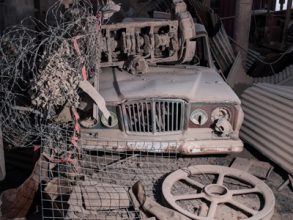
Quoting playwright Bertold Brecht, Neville explains that The Battle Against Stigma uses a form of self-reflexive realism that “does not cling to tried rules of narrative” but rather is “wide and political, sovereign over all conventions”. The idea is to devise new ways to render reality – in this case, that of war. Made over a period of three months, The Battle Against Stigma offers a spare and haunting departure in the relentless portrayal of this international conflict. Bloodless, the mutilation and graphic violence of war go unrecorded (apart from the slaughter of one goat on Xmas day). The visual landscape on offer is clearly shaped by the physical and affective constraints undergone by the photographer (the fear on patrol of instant explosive devices – IEDs – “cut down the images I felt able to safely capture”); Neville’s camera is drawn to the figural traces of war: piled up rusting military hardware and vehicles (Russian Cars at Shezad Patrol Base), horrific recreational graffiti made by soldiers (Mural Camp Bastion Helicopter Base, 2) and displays of military and chauvinist prowess (Checkpoint Zezghy). Beyond that, Neville gives us glimpses of the numerous neoliberal spaces opened up by war for capital accumulation: the use of military and security contractors, training camps, private construction work and complex infrastructure (for example, Afghan National Police Training and Ablutions at Shezad Patrol Base).
The events of war do not concern Neville who was given carte blanche in Helmand (the MoD censored only photographs containing sensitive security material; aerial views taken from a helicopter revealing the location of British patrol bases and portraits of Taliban suspects pinned to a wall.) “I tried to do what I do when I take photos in non-war zones; focus on the banal” confides to me the photographer. Sacrificing digital technology, speed and economy of means for Film Kodak Portra, the artist wished to record situations in a way closer to how we experience them. Especially colour. For Neville, digital technology with its beige carpet of synthetic colours has been responsible for de-sensitising the public to war and to wounds. The task was to return “accurate” colour tone to skin and to breathe life back into faces. Especially baby faces. Neville’s continuous focus becomes the gap between innocence and experience, childhood and the exile of adulthood as the result of war and trauma. Yes, We had forgotten that wars were fought by babies. Banality flips over as The Battle Against Stigma unfolds a shocking Children’s Crusade. Chillingly, the process of embedding becomes for Neville less daunting when surrounded by children.
In the photograph On Patrol in Lashkar Gah 2, Neville’s powerful flash spotlights two Afghan children and a wheelbarrow overflowing with yellow plastic containers (presumably for transporting water). Unaccompanied, the couple emerges from utter darkness. Their adult stares reveal how war has forced them to grow beyond their years, Neville suggested to me. (The total number of Afghan children killed or orphaned is not known). Conversely, British troops, barely older, retain a naïve expression, detached from the seriousness of their situations: a ruddy-cheeked teenage soldier carries a pack of Irn Bru cans, Scotland’s best selling fizzy pop drink (see Supplies for Scots Regiment). Surrounded by the Village Elders, in a crimson room, a cheeky tea boy, oblivious to customers, war and Neville, handles a large tin pot. Sometimes, local children behave as one expected: they show their backs as in On Patrol in Gereshk; they pull faces in On Patrol in Nad Ali). But in the image Watchtower, war gets confounded with playing at war, childhood and the loss of it overlap to sinister effect: a young British girl, eager to be photographed discharging her automatic rifle.
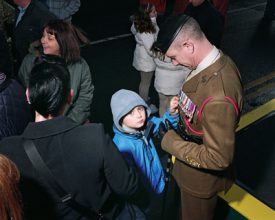
In the last pages of The Battle Against Stigma the photographer and returning veteran documents expected rites of passage and dull, monochrome homecoming parades across UK cities. One photograph haunts all the others: a glowing little boy marvels at the shiny medal of a heavily decorated soldier. Blue-eyed, he gives Neville a quizzical look. What other dreams can we offer this boy ten years from now?
The Battle Against Stigma Book Project, featuring large framed prints from the book, copies of the book, and portfolios of the hundreds of e-mails received from veterans requesting book copies, will tour internationally as part of the group show ‘With Different Eyes – The Portrait In Contemporary Photography’ at Die Photographische Sammlung/SK Stiftung Kultur, Cologne Germany, opening on February 26th 2016.
__________
The Battle Against Stigma by Mark Neville, 2015, is currently being disseminated but is not commercially available. More details at markneville.com
Reviewed for Photomonitor by Emilia Terracciano
Watchtower, 2011 © Mark Neville
On Patrol in Lashkar Gah, 2, 2011 © Mark Neville Russian Cars at Shezad Patrol Base, 2011 © Mark Neville
Homecoming Parade in Glasgow, 2012 © Mark Neville