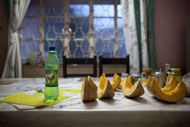
Nestled in the stately environs of Nottingham Castle, Avi Gupta’s intimate solo exhibition There Is Here offers a glimpse into the minutiae of cross-continental living, heritage and values.
The settings are twofold. Gupta, born in Washington DC after his parents migrated, visited several Bengali homes both in his US neighbourhood and in Kolkata (India), where his family origins lie. The resulting photo-series depicts tiny slices of domestic life from both locations, though deciphering which is which is surprisingly difficult – a visual statement on the blurring of definitive cultural signifiers as daily life becomes increasingly globalised.
An immediate observation is that although the images are littered with the debris of human existence, there is a distinct lack of physical human presence throughout. It’s as if for each scene Gupta has arrived slightly too late to capture a live ‘event’ and is left only with objects that hint at a myriad of possible narratives. As a viewer it’s natural to try and work back from these scenes to guess at the personal story of the inhabitants behind them. The series is demonstrative of the dominance of objects in our homes and daily lives, both in terms of consumption and of our increasing tendency to define others and ourselves through material articles.
With the lack of human presence, viewers are left to revel in the textures, play of light and surface patterns of the room decors, which themselves often display juxtaposing links to eastern and western culture. In one a fairy-lit ornamental shrine on the right side of the photograph is offset by the corner of a flat-screen television looming in from the left and set upon an almost classical looking marble-like plinth. As both jostle for position within the image, it becomes an emblem of a truly hybrid world, where the spiritual nature of religious ephemera sits aside the profane coldness of consumerism.
Some of the more textile-based images are reminiscent in composition of Matisse’s interior paintings, with the densely patterned fabrics draped across tables and hanging in windows. The viewpoint of the lens is interesting too. Gupta takes his photographs at different heights and awkward angles, forcing a consideration into the physical positioning of the photographer within the room. Yet again Gupta subtly hints at a bodily presence in these living spaces without overtly revealing anything.
Alongside the There Is Here series is Offerings, a montage of the food and drink offered to Gupta by homeowners in both locations. The mix of cultures is immediately apparent, as is the recurrent interest in material, pattern, the kitsch and natural. The images are placed in a grid formation with the circular form of the offered plates centred in each ‘pixel’ and from a distance the piece appears as a uniform modernist composition, or a repetition of geometric traditional tiles, that only on closer inspection reveals the individual aspects of the same hospitality ritual.
A final addition to the exhibition is Sitting Room, a short film that acts as a subtly poignant companion piece to the photographs. Static objects are animated with the simple addition of light and a soft breeze, offering a sense of life in an otherwise inanimate scenario. Watching light slowly pass over a selection of soft toys, or plant leaves flutter gives the impression of a life presence and also creates a delicate awareness of the passing of time.
The spaces where we spend the majority of our lives are easily overlooked or dismissed, but Gupta manages to highlight beauty in the domestic. His unassuming interior shots are rich with symbolism of cultural heritage, religious belief, consumerist want and human need. In this understated exhibition viewers will find themselves drawn to the lives of others and the fascinating differences that linger in a world threatening to grow ever more homogenous.
– reviewed by Rebecca Travis