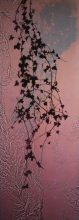
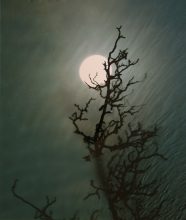
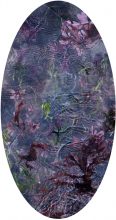
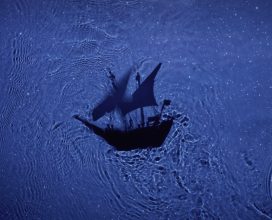

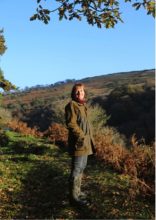
Susan Derges lives and works near Dartmoor in Devon. Much of Derges’ work revolves around the creation of visual metaphors exploring the relationship between the observer and the observed; the self and nature or the imagined and the ‘real’. She endeavours to manifest or capture invisible scientific and natural processes – the physical appearance of sound vibration, the evolution of frogspawn or the cycles of the moon – and is best known for her pioneering technique of capturing the continuous movement of water by immersing photographic paper directly into rivers or shorelines.
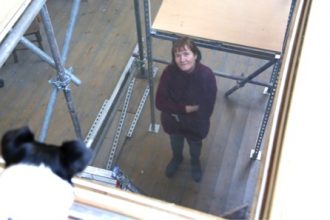
Below, artist and writer Naomi Itami met with Susan Derges in her studio in Devon and conducted the following interview to share insights into Derges’ most recent images and thoughts behind her working process.
__________
Naomi Itami: Thank you, Susan, for inviting me here to your studio in this beautiful part of the world near Dartmoor. I hope to offer the readers some insight into your practise as you have two shows coming up at The Houston Fotofest in March and Danziger Gallery in New York later this year. I know that you spent some of your formative years as an artist in Japan. Can you talk about how this influenced your practice? And were there any particular artists whose work resonated with you?
Susan Derges: I think living in Japan influenced me hugely in terms of the idea of the artist being a sensitive facilitator for something to become manifest. I wanted to be a co-author with nature rather than the kind of genius author who was considered to have all the knowledge and then just stated what was known. Without idealising the culture as a whole, the Japanese aesthetic and attitude towards the natural world that permeates everything from their food to their gardens, made a huge impression on me. Since they were closed off from the world for so long, perhaps they kept some part of themselves intact in a way that we in the West haven’t. Hiroshige and Hokusai were influential in that similar to the photogram, their prints flatten out space. There is something about the vanishing point, both in photography and painting that fixes the observer –an idea of things falling away from a single perceptual perspective. Without this perspective or a horizon, you are able to get references from above and below, sky and ground, in minute detail and a huge overview all collapsed within the same image. It destabilises the idea of a fixed self and Other, and a kind of disorientation or even merging occurs. I think these themes run through all my work.
NI: It was surprising to me when I read that your earliest work actually had to do with sound and the science of it?
SD: At Chelsea (School of Art) I worked in a constructivist studio, making connections with science, new technologies and systems. I was inspired by the minimalist music of Steve Reich and Terry Riley who were setting up predetermined systems that behaved like some living, organic process going in and out of order and chaos. In my early works Chladni (1985) and later, Hermetica (1993), I was interested in working with what lay behind the visible. Using first carborundum powder on metal plates for Chladni, and then mercury in a loud speaker in Hermetica, I was able to see the vibration of sound waves that gave a sense of the universe being innately intelligent. It showed me that we are not concrete things, but rather, we are totally vibrational phenomena.
NI: This sounds like visual music! Your work has been described in terms of cosmic resonances or elemental correspondences that somehow tap into our primal fascination with the natural phenomena of the world— from frogspawn to star-fields to oceans, rivers and waterfalls. Do you consider your work to carry an ecological message and did seeing sound waves make you reconsider some schism that might exist between scientific systems and organic systems?
SD: A lot of scientists right now are sounding like philosophers. They are making connections across disciplines. In my experience it doesn’t make sense to think that we are separate from what is out there in the world or that we are unrelated to it. That kind of separation can lead to alienation and the desire to control what we perceive as Other. There is a resonance between what we are, what we are made of and the outside world. And there is a recognition that all matter, matters. A lot of my work has been about interdependence and interactive relationships we can never fully see but maybe intuit. I didn’t expressly set out to make an ecological message, but I’m certainly not averse to people thinking there is one inherent in what I do.
NI: Who was it that said ‘the future isn’t what it used to be’? Perhaps our degradation of the natural world is because we do feel so separate from it.
SD: Yes, I think so. The flip side of scientific progress is its desire to manipulate and gain control rather than trying to gain insight into what is needed at the moment in order to survive. What I had wanted to do in my work in the early days was to talk about this schism. In The Observer and Observed (1991), the observer finds herself in the observed and vice-versa. A lot came together in that piece: the gaze, the ambiguous gender, the way the eyes seem to follow you wherever you are from within the drops of water. I’ve noticed that people gravitate toward it.
NI: In The River Taw (1997-99) series there is no self-portraiture but your hands and body were facilitating it, so your presence is implied and I would say, felt. There is this sense of embodiment with the one-to-one scale of the prints and the photograms as direct imprints. Was there a conscious decision to place both yourself and the viewer in a more direct relationship to the subject matter?
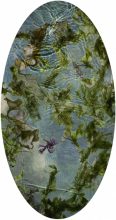
SD: Yes, the whole process of working with the River Taw in Dartmoor was one of self-discovery and an exploration of my desire for a more tactile contact in the work. I was trying to get away from the distancing effect of lens-based photography, so the idea of submerging the paper beneath the rivers surface worked, on both a metaphoric and literal level, with the theme of immersion. Here I wanted the process to be the governing factor and was prepared that it might be quite disorienting and abstract for people. The idea of a river having a memory of its own history, carrying leaves, rocks, and sediment, and thinking of the water as a circulatory system, was present for me. The scale of the prints was about making a direct relationship with the body, while also dealing with the materiality of water. I started out as a painter, so I guess the question of materiality is always going to be there.
NI: But it was kind of performative too…
SD: It was performative but in a way, I had very heavily edited any idea of myself out of the performance in the beginning. As time went on however, I started to learn that my subjectivity and my intuitive inclinations were as indivisible from the process of making, as an observer is from an observation in scientific or natural contexts. As opposed to a view of being alienated and cast out of the natural world that some contemporary art seems to be preoccupied with, I’ve intentionally pursued a more holistic perspective. In the River series I wanted to focus on a sense of belonging and, through my relationship to the River Taw, our connection to nature.
NI: So you moved out of London at this point because of the need to work in the natural world?
SD: Yes, I was ready and already thinking about making work outdoors; and as it turns out, there was an ancestral pull as I later discovered my father’s family were all from here and worked on the land. Rivers had been a possible subject, and I was interested in water as an expression of a universal alphabet—the building block for life within us and outside of us, as well as it having both qualitative and quantitative properties. I wanted to make connections between matter coming into being and the development of form out of nothing. With the River Taw, there were particular forms and places that had a kind of magic, or presence. It’s difficult to articulate exactly why but when preparing to work at previously selected sites, I noticed I was full of energy at certain times and not at others. I became very aware of my response to not only place, but also seasonal, lunar and weather cycles. I suppose what happens is a ‘tuning in’ to the place, and then to memory, idea, and experience. The body of work titled Kingswood (1999), was similarly a tuning in to the cycles of the forest, expressed by the mushrooms and blue bells. They also held subjective meaning for me and it was the projection of this content onto them that became the work.
NI: The way the mushrooms float, their colours and their singularity make them emblematic of decay and life at the same time. Did the whole Barthian notion of death and freezing time come into play when you were making this work?
SD: Oh, that was really big. I was in the process of a lot of personal change and it was quite a dark time for me, so the work became about looking at things dissolving back into darkness. Everything— the mushrooms, the fungi and the blue bells–you’d get a particular kind of low, shafting light and it would penetrate the undergrowth and transform these things into luminous, glowing objects in the dark. I thought they could be made into both negative and positive imagery, so I took my enlarger and set up a darkroom in the heart of the forest, exploring, enlarging and projecting through the subject matter. In almost everything that I’ve made you are looking at light passing through something, which is very different to reflected light.
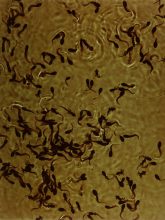
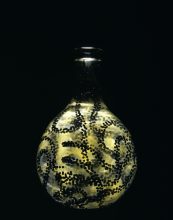
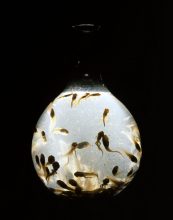
NI: I understand that the idea of using the landscape at night as your darkroom happened early on with Vessel (1994) and the evolving frogspawn.
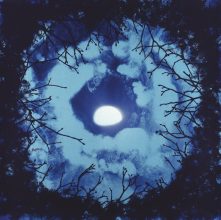
SD: Yeah, the idea of making images outside at night with a flash had already happened in the early 90’s. Using the landscape as my darkroom made many things possible. I became really aware that the prints were coloured by the moonlight. A full moon yielded prints that were at the blue end of the spectrum, a new moon tinted them green. Over the years I have developed a close relationship with the moon, and on occasions have become quite obsessed with its phases.
NI: Is this how Moon Series (2006) was initiated?
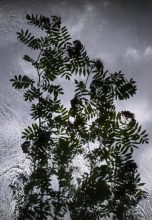
SD: Yes, but by this time I had started to get concerned about the photogram’s depth of field being very limited. I had been working in Scotland and I was absolutely transfixed by the night skies juxtaposed with the trees and branches and the stars shining through. That was a point of frustration for me – how could I get all of these near and far elements into my images? So with a large format camera I started to photograph the moon and the star-fields. I later printed them onto large sheets of film that were placed over the photo-paper so that they would act like a kind of screen. It is always difficult for me to know how to talk about the work without describing the process, even though people get totally caught up the techniques, which really isn’t the point. It’s always a sticky subject with me.
NI: You have a remarkably flexible approach to photography moving between conventional camera-based photography, that includes colour, silver-gelatin, and digital techniques, as well as the camera-less work for which you are most well-known, and which seems to end with the Moon Series. How many years were you making photograms and have you stopped now?
SD: I guess it was from 1992 to 2009. It’s shocking for me to realise it was that long. It was always an unfolding inquiry that led me to use a camera for some but not other projects. I never want to label myself or identify with one single body of work. Also in processing the photograms I became very allergic to the chemistry. When I stopped processing my health returned, so that was it. I think I’d reached the point anyway where I wanted to work in the studio with a camera again. I didn’t want to go on repeating myself and the old way of working was actually coming to an end. Also the paper I had been using became unavailable.
NI: I understand that a lot of artists had to rethink their methodologies with the death of Cibachrome.
SD: I think there’s a huge loss that this paper no longer exists because it was just the most fantastic, classic paper, but I managed to find an alternative approach. Now I work with a digital Hasselblad in the studio and Lamda paper for my prints. I can photograph water and related subject matter from above and from below through a glass tank. It’s incredible because for the first time, the below is visible. The frustration of working with photograms was not being able to see what was going to happen on the photograph. It was a process of pure chance and I had to work more intuitively. It could also be physically very challenging. This way forward for me has huge gains in terms of control, but as with everything, it has a loss as well.
NI: Intuition seems to factor prominently in your practise. This realm is often attributed to women and their perceived connection to nature, cycles, childbirth, etc. Do you bristle at being called a woman photographer?
SD: No actually I don’t bristle because I think there is a difference between art that is produced by women artists and their male compatriots. I wouldn’t want to be showing continuously in a context of feminist art, but I am very aware that my passage as a woman has determined many of the bodies of work that I’ve made. I think the themes of change, fluidity, process, as well as seasonal and lunar cycles are perhaps more visceral personal experiences and therefore more palpable in the work. When I think of the early work as focused on the birth end of the spectrum and my latest work to do with transience and things dissolving out of form, it all circles around life-stages. There’s no question that my experience as a woman has played a huge part in my work and that it would be different if I were male. There’s no doubt about that.
NI: You’ve mentioned dreams you’ve had as sources of creative inspiration, almost as messages from your sub-conscious in advance of projects manifesting. This fusion of the rational with the irrational or the dream state with hard science, runs as a thread throughout your work and makes the case that both sides are equally valid.
SD: Yes, one without the other really is lopsided. I consider my dreams to be as important as my physical and mental presence. Dreams are different forms of awareness and have guided me in my work. Before King’s Wood and actually before my newest body of work Tide Pools (2015), I had vivid dreams, and both had feminine themes, indicating the path of making the work.
NI: Finally, can I ask you to speak about your latest work Tide Pools (2015) that were recently on view at Purdy Hicks in London?
SD: As it’s new, I’m reluctant to pin it down too much. However I would like to say a few words beginning with a dream I had several years ago:
I was on the edge of the shore, making something on the rocks – it was a small creation, a home of some kind, and I was pleased with it after I had finished lime-washing a beautiful pink surface onto the rock I was working on. I stood back to admire this work when a huge wave came across and swept it all away. I was surprised but it also seemed somehow inevitable….
The themes concern the fragility of life, the microcosm of the tide pool on the edge of huge forces both from our environment and the wider cosmos above; the ever-changing forms of ‘home’, which are inhabited by the creatures and seaweed deposited by the tides until the next wave refreshes and alters the inhabitants and their relationships. There is something very feminine about all of this: the relationship of the moon to the tide, the fluidity and liquidity of forms floating and formed by seawater, and the precariousness of the pools compared to the enduring rocky cliffs and eroded geology of a deeper time. The pools speak to the inevitability of change.
NI: Somehow this idea of inevitability is linked to the idea of things coming through us rather than because of us. Would you say this is a theme in your work? Would you say there is a spiritual dimension to your practise?
SD: I would say there are things that live through us, or want to express themselves through us and if we could just get out of the way, we would do exactly what we are meant to be doing. I think meditation is the best way to try to do this, because it allows you to be in a useful relationship to your bigger self. A lot of struggle in life is dealing with one’s identification with things that are changing rapidly and then the need to get dis-identified, and not knowing where you were in relation to these things. I’m not sure about a spiritual dimension to my work, but I do think there really is no separation between our selves and what we see. As a maker this is a major preoccupation.
NI: Your work seems to have finally arrived at a holistic integration of sorts, fusing inner perception with the phenomenal world, the mind with the body, and bridging the divide between self and other.
SD: The themes in my work are about integration, yes, and it requires cultivating one’s sensitivity and openness, but then because you have it, it’s going to mess your life up; well not mess it up, but it is going to be a rocky ride! You get knocked a lot and if you are in the territory of trying to tune in creatively, then you are wide open and so you get knocked around even more (laugh). And it’s a contradiction because you’ve got to be vulnerable and open in order to do good work.
NI: I think there’s a magical quality to when good art comes into conception. I also think these moments are rare and that one is lucky when they occur.
SD: Yeah, there are one or two that happen now and then, and the rest is kind of just looking for it.
__________
Exhibitions:
Susan Derges will be exhibiting in the upcoming Houston Fotofest Biennial Changing Circumstances: Looking At The Future of the Planet 12 March – 24 April, 2016, Houston, Texas
Purdy Hicks, London exhibited Susan Derges: Under the Moon 20 November – 22 December, 2015
Danziger Gallery, New York will host an exhibition of works by Susan Derges in Autumn 2016.
Full details of images at right: