




__________
Ambit: New Photographies from Scotland is a joint initiative between the only two dedicated photography venues in Scotland: Street Level Photoworks, Glasgow, and Stills, Edinburgh. Ambit launched in 2017 and the biennial exhibition takes place across both venues as a way of “celebrating new and diverse approaches to photographic image making in Scotland”. There is no overarching theme, nor is there a formal selection process: instead, artists are invited by the curators at each institution: Ben Harman at Stills, Malcolm Dickson at Street Level Photoworks.
The unusual plural form, ‘photographies’, in Ambit’s subheading points toward an embrace of diverse photographic techniques. Several artists push beyond the confines of the wall-mounted image. Despite the diversity of approaches and the lack of unifying concept, a number of thematic threads do emerge. Both Iain Sarjeant and Alex Hall, for example, are informed by economic failure: At Stills, Hall’s Trauma (2018) is a series of close-ups from a car scrapyard; at Street Level Photoworks, Sarjeant’s Out of the Ordinary (2016-18) shows Scotland’s empty carparks, suburban privet hedges and saw-tooth warehouse roofing. Sarjeant’s beautifully observed images are at once witty, weird, and devastatingly depressing.
The meeting of sea and land is another recurring interest. In Mhairi Law’s The Darkest Dawn (2018), the coastline is a place of tragedy and mourning. The work – a series of five digital inkjet prints from medium format negative scans – was commissioned by arts centre An Lanntair in the Outer Hebrides, to commemorate the centenary of the 1919 Iolaire disaster in which 200 men drowned as their ship struck rocks in the early hours of New Year’s morning. Across Law’s five images, each an enveloping square metre of mole-soft matt black, day slowly rises in the sky and the silhouette of land appears. Light catches occasionally upon a needle in the waters, a barely-there monument to those who lost their lives. In the final image, a low-down splash of white spume alerts us to the invisible rocks.
Both Frances Scott and Brittonie Fletcher walk the shoreline for less tragic stories. Both are presenting work from a Stills-hosted research residency on Orkney focusing on the work of Gunnie Moberg and Margaret Tait. Scott’s Undertow (2019) points to a tension between the artist’s impulse to document the experience of the walks and the desire to be, as she has written, “free from the need to document everything”. The private walks become public in the gallery though three crisply composed black and white photographs hung together as an innovative triptych. The first shows a tangle of wire curling along a wall of lichen-patched stone; the second is a concrete coastal wall; and the third is filled with the waves fading from dark up to light as if the sea were a landscape in itself (no need for land or sky). Like Law’s work, these are digital prints from medium format film. Adjacent hangs a series of twelve minimal maps and phrases that evoke aspects from individual walks, each like a page from a book. Personally, I prefer Scott’s looser aerial drawings and a hand-written map of almost overwhelming complexity (not included in the exhibition). The photographs already demonstrate precision; an occasional rough edge could make this project sing.
Fletcher is probably the most technically experimental artist across both exhibitions. With a focus on the texture of the image, an interest in geology, and a glimpse of the power of the Orkney winds, Fletcher’s diverse works include a hand-applied liquid emulsion print of the marks made by grass in the sand (Signs and Symbols, 2018); ten exquisitely detailed chemograms (Rock Portraits, 2019); and a pair of silver gelatine prints that show the shore grasses sculpted into ridges by the force of the wind (Grasses: North then West, 2018) reminiscent perhaps of Richard Long’s A Line Made By Walking (1967). Her C-print of an unidentified found object, The Disc (2018) is an extraordinary swirling galaxy of tones and textures – copper, bronze, turquoise against a black void of a backdrop. Harman has said that Ambit should showcase works in progress; Fletcher has embraced this ethos whole-heartedly.
For me, the highlight of Ambit 2019 is the pairing at Street Level Photoworks of Edyta Majewska’s politically urgent installation with a series of symbolically charged black and white photographs by Katy Hundertmark (Studies in Gravitation, 2018). After working in sculpture and performance, this very recent project constitutes a double return for Hundertmark: not only to photography but also to a site of personal significance – an abandoned farm in Germany owned by her ancestors. The photographs enact multiple ritualistic excavations: of crabapples, of memories, of pain. The artist’s face is never visible; instead we see hands and tools, white forearms in the dark earth. Antiquated tools are arranged into sculptural forms. Seated self-portraits show the artist holding a chunk of local slate or an intestine-like tree root crown as a symbol of digestion, both literal and metaphorical. A white-shrouded figure lies in a ploughed field.
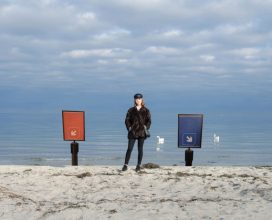
On the other side of the gallery, Majewska’s Other White (2018) is an installation made up of Polaroids, a short film, an artist’s book, wallpaper of densely repeated patterns and a questionnaire on British history in imitation of the test that prospective citizens, such as Majewska herself – born in Poland and living in Glasgow for 20 years – must pass. As I watch her film of a woman sweeping a sports hall and listen to audio of Nigel Farage claiming his “victory for ordinary people”, I feel myself boiling with rage. One photograph shows Majewska’s daughter standing on a Scottish beach, between land and sea, between categories of citizenship. Both Majewska and Hundertmark approach the question of belonging, of our bodily relationships to community and the land. The personal and the political can rarely be teased apart.
An ambit, incidentally, refers to a field or zone of influence, even control. From the Latin verb, ambio, I go around, it suggests the need for an encircling border or some kind of identifiable limit. A shoreline is one such place; the body is another. As the photography in Ambit suggests, the limits of both are on the move.
– reviewed for Photomonitor by Tom Jeffreys
__________
Ambit: New Photographies from Scotland
is showing across two spaces:
Stills, Edinburgh, Scotland
12.04.19 – 02.06.19
Street Level Photoworks, Glasgow, Scotland
13.04.19 – 23. 06.19