

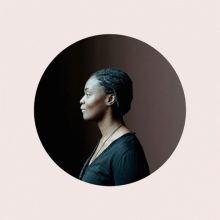
Today we see so much large scale photography on the walls of museums and in contemporary art galleries that many have begun to believe that all contemporary art photography needs to be big. In this context, it might seem to be a statement of some sort that Bettina von Zwehl has chosen, in her show at Purdy Hicks Gallery end of 2011, to go very small in scale. This work was developed in a six month residency at The Victoria and Albert Museum. Specifically referencing the museum’s fine collection of miniatures and 19th century silhouettes, von Zwehl in composition, scale and framing has mimicked this much earlier style of portable portraiture.
But it is not only the scale of this new work that makes this series notably different to her previous work, but also her use of natural, as opposed to artificial, light. She has described during her residency how she “came across this particular window… that seemed to emanate a glow all of its own – diffused, yet clear… a giant soft-box.” Using this light source significantly alters the light tones and hue but also the colour in the work.
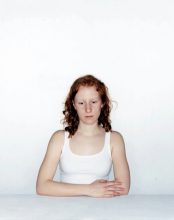
Compare and contrast one of her portraits from her series Alina (2004) to one of these new works. In Alina von Zwehl has used flash lighting in a dark space, so that the background is bleached out and white. The stark and harsh lighting alters the colour balance of the subjects’ skin. They have been asked to wear uniform looking tops also, so that colour in clothes is not a distraction, with an aim to have different people shown in a similar formal way.
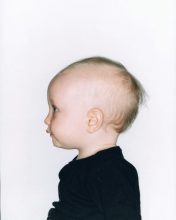
In this recent work the colour and light lends the work an almost overtly painterly quality. Perhaps this is most clearly seen in the portrait Jana II homage to Richter. Von Zwehl’s show was held concurrently with the large Gerhard Richter exhibition at Tate Modern, with the expectation that a visitor may see both in the same day. As one of those visitors it was an interesting juxtaposition to see a photographer influenced by painting alongside a painter so indebted to the impact of photography. It struck me that another nod to this conversation between artists was also referenced with the inclusion of a small portrait of von Zwehl’s daughter Ruby close to the front of the space. Richter is of course well known for the use of his daughter as a recurrent subject in his work.
The subjects of von Zwehl’s new portraits range from one other young child, and female staff at the museum including a staff photographer, a teacher from the education department and a cleaning lady. But in the main they are Gallery Assistants. A previous photographer who chose to turn the camera on gallery workers was Keith Arnatt in An Institutional Fact (1973). He took full length portraits of the security guards at the Hayward Gallery London which were included in a show there. Arnatt’s work can be read as a social comment. In the past there has been a set type and class of person who would be the subject of a commissioned portrait. Workers in the museum would not usually be depicted. But there is also an interesting play here of turning the lens onto those people whose work it is to look at those looking at work. Here we observe the observers.
Casting subjects has always been a key part of von Zwehl’s practice. In this series she has chosen to depict only women, which is not unusual for her. Often her call out for subjects has led to a situation, which other portrait photographers discuss, where young women seem more likely to respond and select themselves to come forward. There might be many reasons for this but clearly working in a museum presented the artist with the option to draw in a new group of participants; a hook which has enabled her to broaden her reach and the type of woman she can photograph.
Another distinctive departure in this new series is that a central part of this work includes a series of portraits of the same person, Sophia. A number of contemporary artists have repeatedly used the same person such as Roni Horn in her well known and beautifully executed series You are the weather, Part 2, (2011) and Elina Brotherus who repeatedly turned the camera on herself in her recent series Time Series IV, (2010) to name but two. In both these series it is amazing to see the enormous and the minute changes that a person’s physiognomy can go through even in short periods of time. One effect of such a rigorous study of one person is that the aging process, however subtle, becomes readable across the work. Emotion and mood also become evident as does the subtle alteration of light and the time of day and seasons.
For me, having come to look at this work very soon after thinking and writing about identity politics in photography, it seemed significant that the subject here is a young black woman. As has been explored by Lorna Simpson, Joy Gregory, Adrian Piper and many others, there is a particular significance when a black woman becomes the subject of portrait. The colonial legacy casts a long shadow. Again in connection to Lorna Simpson there is also a whole language around hair and hair styles. In many shots of Sophia we see what would be usually hidden in public under a wig. At times her hair is braided, in one work it is more loose and afro-like. It also feels that the subject is very complicit in allowing us to see her in this more intimate way.
It strikes me that previous portrait series by von Zwehl have aimed to either choose subjects that are too young to be aware of the their own self-image, or have subjected the person photographed to an experience (waking them from deep sleep, exposing them to extreme heat, shutting them in a dark room listening to music) that does not allow them to be in control of how they look at the moment they are photographed. In this new series none of these processes have been employed. Instead she has turned to a much more traditional, formal and reciprocal approach to portraiture.
The title of this work is Made Up Love Song. The series which has taken time to make has lead to a relationship developing between artist and subject. The final work ends up bearing witness to that. There seems a significant shift here in the relationship between artist and subject, which in its nature moves to much more tender and ultimately romantic terrain. This work represents six months of meetings between Bettina and Sophia. We see the trust and the generosity of Sophia who has agreed to collaborate and become part of the artist’s work. The subject has shown to us her hair without the wig and the artist has allowed the sitter to be poised and controlled and the knowing subject of the photograph. In this way both women have let go a bit to work together. This reference to an intimacy, and a relationship to love songs, of course sits so well the 19th century miniature format which the work mimics. The reason miniatures still hold such allure is down to their original purpose and connection to relationships and love. The miniature was at its essence the visual and portable version of the contemporary love song – commissioned and cherished by those in love.
Bettina von Zwehl’s show Made Up Love Song and other works was held at Purdy Hicks Gallery London 7 October – 7 November 2011.