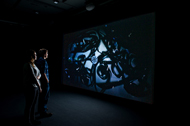
Cinematic experience can undoubtedly feel physical, emotional, visceral, but is by nature a fluid and intangible entity, an edited reduction of imagery captured through a lens, projected through light, read on a disc, emanating from a screen. With the advent of CGI and the ability to construct hyper-real scenarios in any time and place, it often feels as if the mainstream cinema experience is becoming even further removed from physicality, yet Darren Banks’ single-channel video installation at the Tyneside Cinema Gallery – following its premiere as an off-site commission for the Venice Biennale last year – brings focus back to tangible movie ephemera. This is Object Cinema.
The key protagonist in Banks’ seamless video loop is John Carpenter’s 1982 horror film The Thing, though through the work we journey from its predecessors – the short story Who Goes There? first published in a magazine in the 1930s, its early incarnation as a book and mid-century film adaptations – and into its subsequent remake and reissues. These various formats and interpretations are introduced, not with narration or verbal explanation, but by a pair of demonstrative, magician-like hands against a dark void backdrop, which present each object or viewing format and initiate its evolution into its next permutation.
Before our eyes (and to a reimagining of Enrico Morricone’s pulsating soundtrack from the Carpenter movie) a copy of the original magazine transforms into a paperback version of The Thing, which opened becomes a laptop on which a screen of cells replicate, and so on. Illusory tricks – sleight of hand, dry ice, a puff of green-hued smoke – are employed in the transitions, along with plays upon tropes from the horror movie canon. As the soundtrack reaches its crescendo at what could be considered the centre-point to the piece (though essentially it is without beginning, middle and end), the hands open a book copy of The Thing to reveal a messy, animated contortion of tentacles and B-movie goo. The unfortunately low sound levels, however, meant that this scene, with its traditionally hand-rendered prop, lacked its presumably intended punch.
Banks’ selection of The Thing is intelligent and well utilised, for as the formats spin, spool and spawn on screen, they mirror the mutations inherent in the story itself. Just as the indefinable creature morphs and reinvents itself (as in the classic head sprouting legs scene shown as part of the work), so too do the distribution methods and technologies of cinema and storytelling. Object Cinema is a romp through filmic formats, from celluloid (a nod to an early film rendition of the story, ‘Horror Express’, is magically spooled through the hands), to VHS, Laser disc, DVD and digital file. A re-published copy of the short story takes on cover imagery from the Carpenter movie, posters are unfurled, protective sleeves and cases become portals for reinvention. The back and forth fluidity of the object transformations seems indicative of the ease of media sharing and of the erratic carousel of technologies becoming obsolete and then nostalgically rediscovered.
Object Cinema is the product of evolution itself, a descendent of Banks’ ongoing Palace Project in which he and a selection of artists re-imagine classic movie posters, and a continuation of themes apparent in installation works such as Evermore shown at neighbouring institution BALTIC 39 in 2013. Perhaps most valuable in Banks’ practice is his expansive attitude to the media in which he works. In an interview with Elisabette Fabrizi, Tyneside’s Gallery Curator and co-commissioner of Object Cinema, she asks how he would describe the work. “I think it’s a sculpture, essentially” says Banks, “a selection of objects held in space” – and so Object Cinema continues the evolution of media, formatting and physicality on screen, in which a magazine short becomes a cult horror movie and in which a 2D moving image work can be considered as sculpture.
– Review by Rebecca Travis