A boy stands in a back street of Blackpool; he is bare-chested and his hands hold on to a chained dog that sits between his legs. The boy and the dog both look wary, poised with a sense of readiness, but for what? This is not made clear: the only information the caption provides is the boy’s location and the date that the photograph was made. A large print of Adelphi Street, Blackpool, August 2012 is the opening picture of Niall McDiarmid’s exhibition, British Portraits, at Oriel Colwyn. It is partnered with an image of two girls, photographed on a street in Sandown on the Isle of Wight. The boy appears to be a similar age to the girls but they are separated by distance and time; the adolescents meet on this wall in North Wales sharing their likenesses and their sartorial choices.
The prominent feature of this exhibition at Colwyn is the grid of forty-one colour photographs. Amassed on one wall are portraits of people recorded in towns and cities across Britain. The viewer is drawn into making comparisons between these images. What does each picture tell the viewer about the person depicted or the location that they inhabit? The picture titles do not state more than a time and place. These people may or may not all be British; they may live in the named town or just be passing through. The collection reflects life in contemporary Britain where questions about belonging have been raised by the conclusion of a pro-Brexit vote and the call for Britons to ‘claim back’ their country. McDiarmid’s project, begun in 2011, follows nearly one hundred years after the conception of a visual catalogue of populace by the German photographer August Sander. Sander’s People of the Twentieth Century has become the archetype for portraiture that explores type, and was constructed at another juncture in European politics when belonging was paramount.
The titles for Sander’s photographs classified his subjects by profession or social class; McDiarmid’s titles draw attention to his and his sitters’ location, even though little is revealed in the image – no feature or landmark – to confirm this. McDiarmid is based in London, and thi is where his exploration started. Photographing people on the streets of the capital could have provided him with the diversity that he sought, but perhaps being a Scotsman made him aware that the country as a whole exists beyond the metropolis. A map of Britain, dotted with coloured pins, shows the places that McDiarmid had visited. By employing this device of the actual map to face the grid of portraits, the viewer not only meets McDiarmid’s people but stands with them on the street. A number of British photographers have undertaken a journey exploring British identity, notably Ton Ray-Jones, Martin Parr, and more recently, Simon Roberts. McDiarmid’s project fits into this canon, adding something to the understanding of the state of the nation.
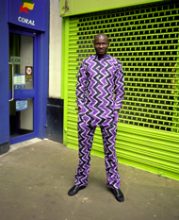
McDiarmid’s work is as much about colour as it is about people and place. This photographer selects his subjects in relation to their appearance in the manner of a street-fashion photographer. Colourful backdrops serve to highlight the clothes of the people that he meets. This deliberate tactic moves his pictures from the drabness of a clinical survey to become stand-alone compositions. An example of this is the picture Coventry, March 2012 in which a black man is dressed in a suit that zigzags purple and black stripes across his frame. This is eye-catching by itself but McDiarmid has placed the man in front of a vibrant lime-green shutter and the ultramarine blue of a local branch of the Coral betting shop. The result cracks open the monotone British reserve to, literally, bring colour to the fore.
McDiarmid’s project is ongoing: his travels around Britain continue. As a part of this exhibition in North Wales he has photographed along the coast from Chester to Caernarfon. Sixteen prints surround a map of the North Wales coast, and each image is tied to a town. The photographer and the gallery deftly include the local communities in this survey. Clearly, this project has become a rejoinder to the disunity of Brexit, bringing people together rather than separating them. It has given the photographer an opportunity to move outside of London and bring back the rest of the country to stand by the citizens of its centre. On a more prosaic level, the project records current fashion trends, both street fashion and the clothes of the everyman. The boy in Blackpool may be wary of the future but he is in good company, one that has embraced diversity instead of enforcing the uniform.
– Reviewed by Stephen Clarke
__________
Niall McDiarmid is a Scottish photographer based in London. His books Crossing Paths: A Portrait of Britain and Via Vauxhall have been published by Hey Little Heroes. www.niallmcdiarmid.com