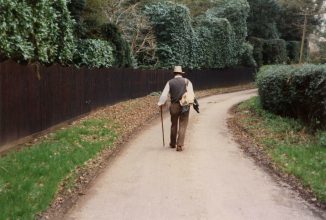


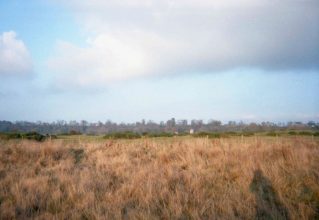


Winfried Georg Sebald – known as WG to the literary world and as Max to his friends – was born in the Bavarian Alps on 18 May 1944. After studying German and English Literature, first at the University of Freiburg (Germany) and then the University of Fribourg (Switzerland), Sebald came to the UK in 1966, where he was a lector at the University of Manchester, before moving to – and settling in – East Anglia, with his Austrian-born wife Ute, in 1970. He first became a lecturer at the University of East Anglia (UEA), later being appointed to a chair of European Literature, and going on to become the founding director of the British Centre for Literary Translation. Author of four genre-defying novels, largely concerning the themes of memory and loss – Vertigo (1990), The Emigrants (1992), The Rings of Saturn (1995), and Austerlitz (2001) – as well as numerous essays, Sebald was tipped as a potential future winner of the Nobel Prize in Literature when he tragically died, in 2001, aged just 57, in a car accident, triggered by an aneurysm.
What is perhaps less known about Sebald than his writing is the fact that he was also a photographer – for the most part using a small, point and shoot, 35mm film camera set to automatic – and, in fact, his images act as a significant form of punctuation in his novels, both interrupting and illustrating his infamous digressions. In The Rings of Saturn in particular – the German subtitle of which, ‘Eine Englische Wallfahrt’ (‘An English Pilgrimage’), says something of its rambling narrative – the storyteller, not directly Sebald, but clearly his channel, travels some 80 miles on foot through the once-important towns and villages, and along the coast of Suffolk, exploring East Anglia, one minute writing about its wheat fields, wetlands and medieval churches, the next wandering off on ruminative excurses about slavery in the Belgian Congo and the Anglo-Chinese opium wars, all tenuously linked to people or events from the region. Reading Sebald requires patience (and an essay film of this name was made by Grant Gee in 2011, exploring his East Anglian walk) – one passage in Austerlitz contains a sentence that is nine pages long – but his language is a heady and lyrical dream, especially to an ex-Germanist and syntactician like me.
He describes scenes of bleakness and emptiness, with a melancholy and pathos, as if trying to overcome his own sense of a national inglorious past. Of Lowestoft, the most easterly settlement in the UK, for example, he writes:
Outside the beach stretched out, somewhere between darkness and light, and nothing moved, neither in the air nor on the ground, nor on the water. Even the snow-white waves, accumulating in the bay, seemed to me as if they were standing silently.[1]
There follows an image, stretched out into the gutter, somewhere between darkness and light, of a still, silent, deserted beach, with snow-white waves accumulating in the bay created by the groynes. Similarly, of Dunwich, a small village, known as the lost city of England, he says:
This region is so empty and deserted that someone abandoned here would hardly be able to say whether he were on the North Sea coast, or perhaps the banks of the Caspian Sea, or in the Gulf of Lian-tung.[2]
Again, the prose is followed by a bland, deserted photograph of an anonymous coastline.
‘Photography was an essential part of Sebald’s creative process,’ says Nick Warr, Curator of Photographic Collections at UEA. ‘The images in his books are not just “illustrations” added to support the text but are as fundamental to his work as the words with which they share the page. In this respect, the pictures of the Suffolk coast that punctuate The Rings of Saturn are like postcards sent by Sebald to the reader.’
To mark the 75th anniversary of his birth, Norwich Castle Museum & Art Gallery is hosting an exhibition of Sebald’s source and archive materials, including 250 colour photographs taken by the writer, a large number previously unseen, curated by Warr and Dr Rosy Gray, Curator of Modern & Contemporary Art at Norwich Castle Museum. The inspiration behind it is Sebald’s time and travels in East Anglia, in particular for The Rings of Saturn. Also on display are a number of the black-and-white images from the book, printed and transformed in collaboration with his UEA colleague and friend Michael Brandon-Jones. UEA’s photographic archive holds more than 1,000 such images, and a large number of these are being shown alongside Sebald’s manuscript notes and instructions. In the introduction to the catalogue – Shadows of Reality: A Catalogue of WG Sebald’s Photographic Legacy, due out in May 2020 (with a preview this autumn)[3] – Brandon-Jones recalls how Sebald would leave him hand-written notes and lists detailing – albeit sometimes vaguely – how he should print the images, often joining two photographs together, or making a lighter or darker print, or one with more contrast. Where a reflection places Sebald’s shadowy self in a window or puddle, it is undoubtedly deliberate, and a reminder of the narrator’s presence – no matter how unstable his identity might be – throughout the novel.
Frequently Sebald or Brandon-Jones would rephotograph a photograph – as well as objects and works of art – occasionally manipulating them on a photocopier and rendering them almost uncanny. Both this process of creating a new copy, and their collaboration itself, might be seen as a further element of translation, comparable to the translation of Sebald’s words, from his native German, in which he continued to write. Warr suggests: ‘[H]is persistent ambivalence toward the technical aspects of photography (what film he used, the quality of his camera etc) combined with his professed lack of “any artistic ambitions” with the camera speaks more of a will to erase his ownership of the photographs he took than any insouciance about their fabrication (as the evidence of the negatives demonstrates). In other words, it’s like Sebald needed his own photographs to be distanced from himself and become closer in nature to the antique found photographs that he included in his text. […] “A black-and-white photograph,” he stated in one interview, “is a document of absence” – in this case perhaps it his own.”[4]’
Although Sebald was never involved in the actual printing process, leaving that entirely to Brandon-Jones, he was entirely responsible for how the images got incorporated into his text and the layout of the final printed book. Brandon-Jones recalls how Sebald would sometimes construct an elaborate story to match a particular photograph he had found or, conversely, select an image to support the narrative of a particular scene. The line between what is historically accurate, and what is fiction, or embellished, remains, at times, uncertain. But that, along with the layering and collaging, is part of the appeal – in both Sebald’s writing and his images. ‘It would be easy to dismiss his photographs as amateurish snapshots,’ says Warr. ‘But their apparent spontaneity is misleading as it belies a precise and considered working practice that is clearly evident in the archives.’ And where the images are part of the text, they are integral, and thus every bit as worthy of a Nobel Prize as the words themselves. As Warr concludes: ‘Though he never exhibited his photographs in a conventional sense, the small enigmatic, captionless, black-and-white photographs that appear in almost all of his books have had a far-reaching influence on both writers and visual artists’. Both this anniversary exhibition, and the forthcoming book, will extend this influence still farther, making the unseen, archived images, and the information that is held on how they were manipulated to accompany the texts – and vice versa – available to all.
– by Anna McNay
__________
Lines of Sight: WG Sebald’s East Anglia continues at Norwich Castle Museum & Art Gallery until 5 January 2020
[1] WG Sebald, Die Ringe des Saturn. Eine Englische Wallfahrt, Fischer Taschenbuch Verlag, 7th edition, 2003, p51 (trans. Anna McNay)
[2] Ibid, pp186-87 (trans. Anna McNay)
[3] Nicholas Warr (ed), Shadows of Reality: A Catalogue of WG Sebald’s Photographic Legacy, Boiler House Press, May 2020. This catalogue is even farther reaching than the exhibition, covering all of Sebald’s works, from Vertigo to Austerlitz, including a wide range of archive material, and really exploring the collaborative process between Sebald and Brandon-Jones. With 400 pages of full-colour reproductions of film negatives, prints and slides, essays, and an interview with Brandon-Jones, it is set to be a definitive, scholarly publication to complement the exhibition and keep its – and Sebald’s – legacy alive.
[4] Richard Sheppard, ‘Three Encounters with WG Sebald (February 1992 – July 2013)’, Journal of European Studies, 44/4 (2014), pp378–414, p390, cited in Nicholas Warr, ‘Die kleine Geschichte der Re-Photographie. [A Small History of Re-Photography]. A Conversation with Michael Brandon-Jones on the Photography of WG Sebald’, in Warr (ed), 2020, pp20-29, p 29