In ‘The Politics of Contemplation’, a conversation between Zoe Leonard and Elisabeth Lebovici published in 2012, the former reflected on her preliminary explorations into modes of representation, explaining, “I became interested in mapping and archiving. I liked the deadpan appearance of photographs used in science and cartography. I looked at war photographs, especially aerial reconnaissance photographs … the different kinds of jobs a photograph can do. It can be a document, or a record, it can be used to transmit information, or employed as evidence, or proof. It can be a snapshot, intimately connected to memory and emotion. It can be a kind of blueprint of the world, or it can be completely abstract.” (1)
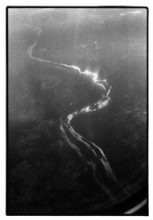
Leonard’s aerial photographs are one of her earliest bodies of work, captured in the mid to late 1980s, with images dating from 1986-89. Exhibited at London’s Hauser and Wirth (her first exhibition with the gallery), these photographs—black and white, printed on fibre paper, unframed—are simply tacked to the walls in groupings of two or three, with significant gaps left between and around them. The blankness of the white walls contributes to a feeling of expansion, a loss of boundaries between the photographs and their viewing environment. In the ‘Aerials’—as they are collectively known—we see rivers, roads, rows of suburban houses, and railway tracks, all captured from an aircraft. There is vagueness and specificity to the work, with Leonard oscillating between presenting the image as a record, as visual information, and providing enough space for subjective or personal interpretations. From above, the urban environment becomes abstracted, with the houses becoming grid-like modular forms, and the weaving roads or tracks akin to threads. The images are imperfect, too, with the black edge of the negative often included in the print, wisps of clouds, the reflection of the window pane, or marks caused by scratches or dust left unedited—the deliberate marks of an artist’s hand, the refusal of the neutral in favour of a tangible materiality.
Much of Leonard’s practice has engaged with themes of mourning, loss, and displacement, the seeds of which can be traced in the detached presentation, and the contemplative, even melancholic, sentiment that surrounds the work. There are no humans depicted in the photographs, but their presence is implied: by the roads (who built them), the houses (who lives in them), the small boat alone on the rippling water (who is sailing). Despite their initial sense of anonymity, Leonard is asking the viewer to consider the political or economic structures that lead to the development of urban landscapes, and the relationship between man-made building and the natural world. The series is cartographic; it poses questions about perception and perspective, through whose viewpoint do we see the world.
Viewed in 2019, an era of rampant development, with advances in drone and surveillance technology, and ‘shot on an iPhone’ platitudes, ‘Aerials’ represents a bygone era: with the sense of quiet we can sometimes only reach when we are above the clouds.
– reviewed for Photomonitor by Philomena Epps
__________
Zoe Leonard: Aerials continues until 9.02.19 at Hauser and Wirth, London
(1) A recording of this conversation can be seen here and read here.